Monghoul against DBeaver
DBeaver and Monghoul on MongoDB, PostgreSQL, ClickHouse, SQLite and Redis, from DBeaver's own documentation: the edition each engine needs, and what happens at a write.
On this page
DBeaver opens far more databases than Monghoul does, and its free Community edition is open source. Monghoul opens five: MongoDB, PostgreSQL, ClickHouse, SQLite and Redis. On those five, every engine is in the free tier, and the differences are in what happens before a write and how much of each engine’s own vocabulary the app speaks.
This page compares the two from DBeaver’s own documentation, read on 7 November 2026. It does not compare speed or memory, because DBeaver has not been measured on the benchmark machine the other comparisons on this site use.
Which edition you need for each engine
DBeaver Community covers PostgreSQL, ClickHouse and SQLite. Its MongoDB and Redis drivers are in the paid editions: the wiki says Redis is “available in Lite, Enterprise, and Ultimate editions only”, and the Lite page names MongoDB as a Lite feature. Monghoul has all five engines in the free tier, with a limit of 8 saved connections.
Some of DBeaver’s tools sit higher still. Its edition table marks the SQL execution plan diagram for every paid edition, and server health dashboards, mock data generation and ER diagram editing for Enterprise, Ultimate and Team, not Lite.
Where Monghoul is ahead
Every grid change reviewed as a table
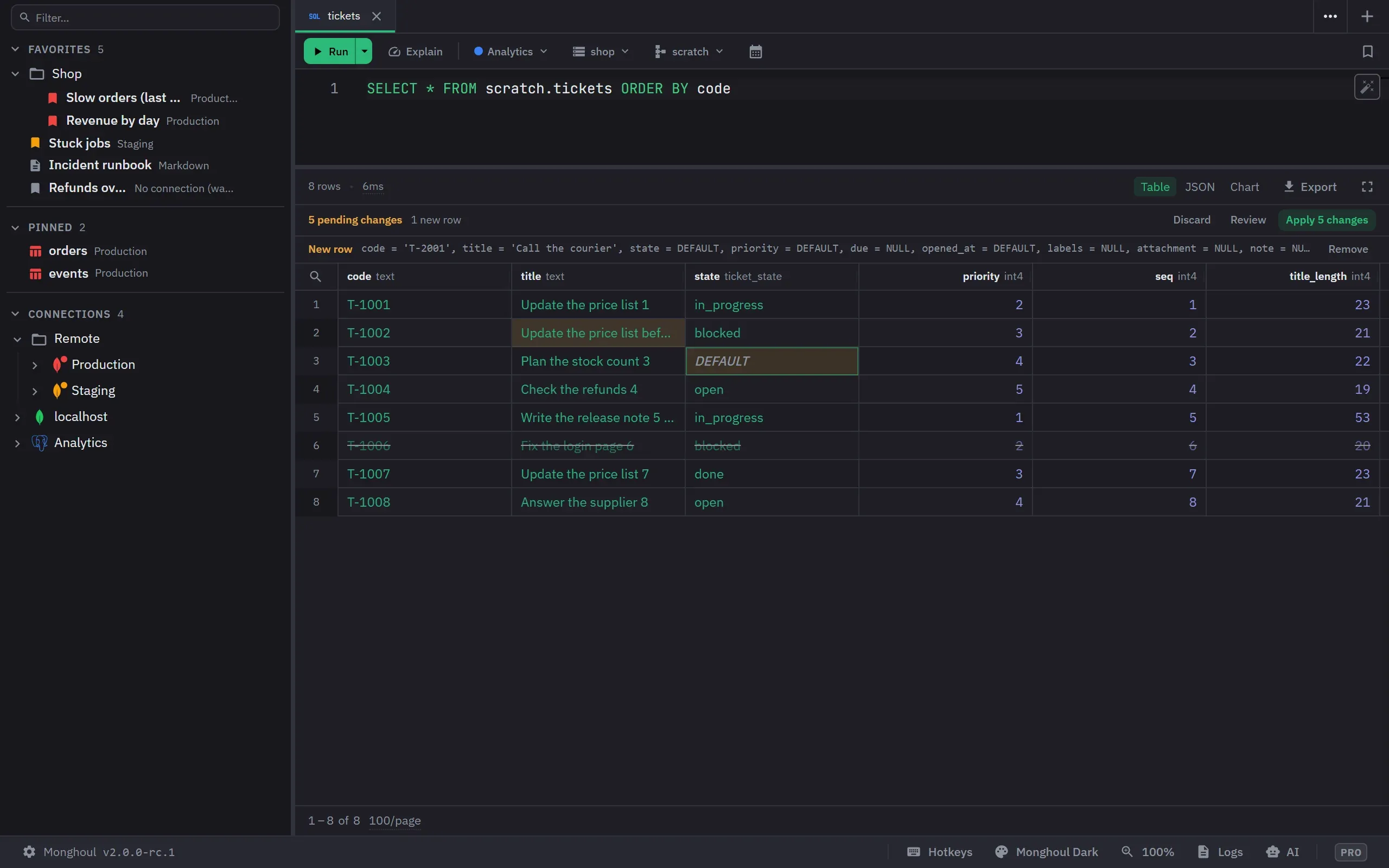
A PostgreSQL, ClickHouse or SQLite result can be edited in the grid, and Review Changes shows every staged change as one table, the old value above the new one, with the SQL and its parameters under it. PostgreSQL and SQLite apply the batch in one transaction, and a row that changed since it was read stops it. DBeaver’s data editor keeps changes pending until Save; its documentation does not describe a preview of the statements. Edit rows in a SQL result.
ClickHouse granules, mutations and sorting keys
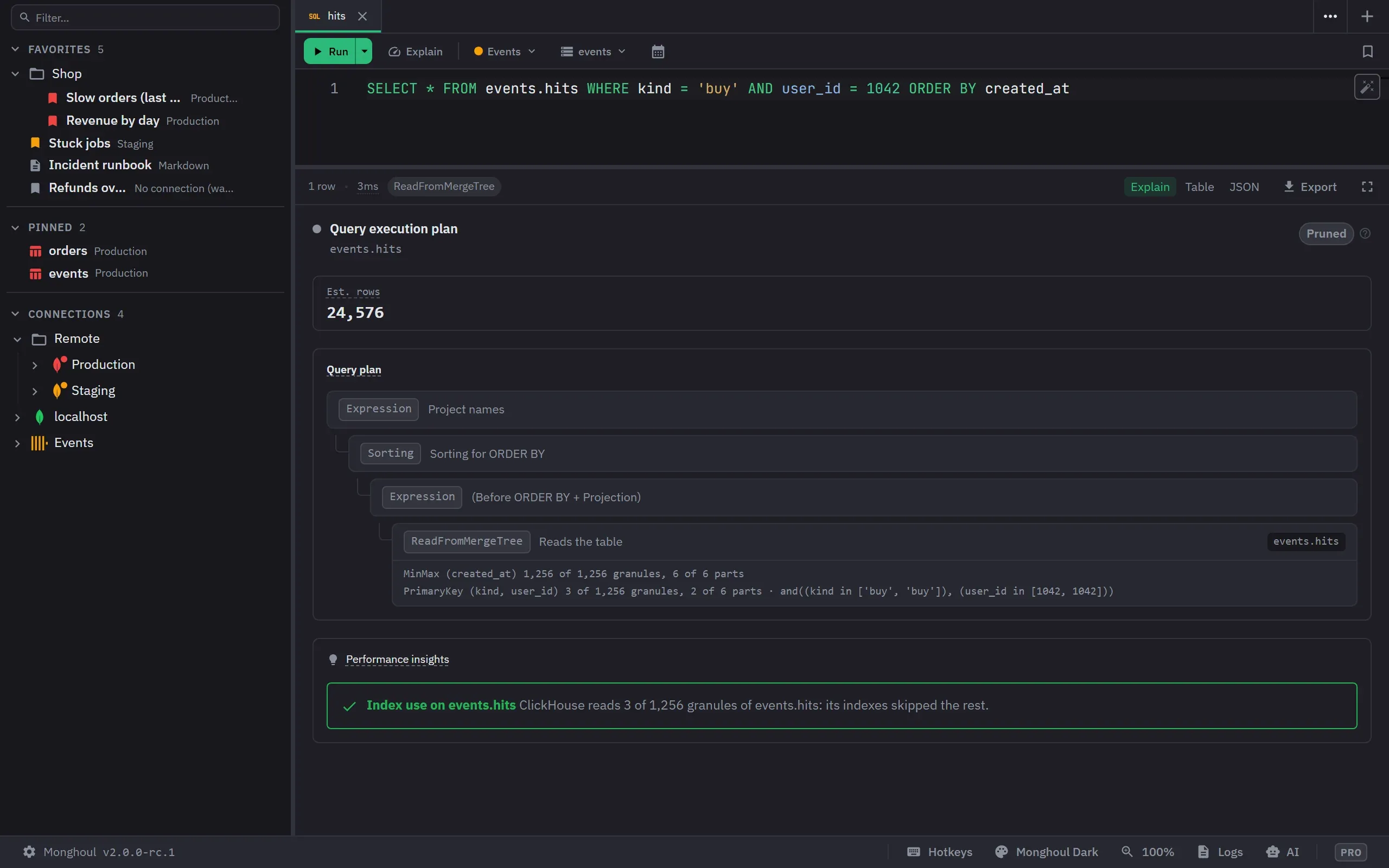
Explain counts the granules a read selects and grades a full read. A mutation asks first and says ClickHouse cannot undo it. A grid edit names rows by the sorting key, and a batch that ends part of the way says what happened to each change. ClickHouse in Monghoul.
Redis edits that check before they write
The key browser scans with SCAN, and the editors stage changes to a hash, list, set, sorted set, stream or JSON document. Before Apply writes, Monghoul checks the values you saw against the key and writes nothing if another client changed them. DBeaver’s Redis wiki describes a key tree and commands in the SQL editor; it does not describe per-type editors. Redis in Monghoul.
MongoDB tools
Autocomplete from your fields and values through each pipeline stage, a visual aggregation builder with a preview per stage, and a Database Map that opens the document an id points to. MongoDB in Monghoul.
One licence for everything
Pro is one $59 payment for a lifetime licence, and it covers every engine. DBeaver’s PRO editions are yearly subscriptions per user.
Where DBeaver wins
Many more engines. MySQL, MariaDB, Oracle, SQL Server, Snowflake and many more, in one application. Monghoul has five. If your week includes an engine outside the five, DBeaver covers it and Monghoul does not.
Open source and free on the SQL engines. DBeaver Community is free for PostgreSQL, ClickHouse and SQLite with no connection limit. Monghoul’s free tier stops at 8 saved connections.
An ER diagram you can edit. DBeaver’s Enterprise, Ultimate and Team editions edit the schema in the diagram. Monghoul’s Database Map draws relations and offers drafts for its findings, and does not edit the schema in the map.
Manual commit on more engines. DBeaver documents Auto-commit and Manual commit modes. Monghoul has Manual commit on PostgreSQL only.
Capability by capability
Where DBeaver’s documentation does not cover something, this table says so rather than calling it missing.
- Yes
- A different approach
- Not in the documentation we read
- No
| DBeaver 26.2.4 | Monghoul 2.0.0-rc.1 | |
|---|---|---|
| Engines | ||
| MongoDB | A different approach. Lite and up, not Community | Yes. Free tier |
| PostgreSQL, ClickHouse, SQLite | Yes. Community and up | Yes. Free tier |
| Redis | A different approach. Lite, Enterprise and Ultimate | Yes. Free tier, Valkey too |
| Other engines | Yes. Many, such as MySQL, Oracle and SQL Server | No. None |
| Before a write | ||
| Confirm writes on one connection | Yes. The Production connection type | Yes. Write protection, every engine |
| Read-only connection | Yes. A security restriction per connection | Yes. Access mode Read-only |
| Review grid changes as a table before they apply | Not in the documentation we read. Changes stay pending until Save; no preview documented | Yes. Review Changes |
| Manual commit | Yes. Auto-commit and Manual commit modes | A different approach. PostgreSQL only |
| Tools | ||
| Visual plan of a query | A different approach. The plan diagram, paid editions | Yes. Explain, free tier |
| Test data generation | A different approach. Enterprise, Ultimate and Team | Yes. Free tier, 500 rows a run |
| Server monitoring | A different approach. Health dashboards, Enterprise and up | A different approach. Cluster Monitor, Pro |
| Redis per-type editors | Not in the documentation we read. Not in their Redis wiki | Yes. Hash, list, set, sorted set, stream, JSON |
| Licence | ||
| Free edition | Community, open source | 8 saved connections, every engine |
| Paid | Yearly per user: $113, $255 or $510 | One $59 lifetime licence |
The DBeaver column was read from the vendor's own documentation, version 26.2.4, on 7 November 2026. It records whether a capability exists, not whether it is any good, which is not a thing a table can hold.
Which one to pick
Pick Monghoul if
- your work is MongoDB, PostgreSQL, ClickHouse, SQLite or Redis
- you want every grid change reviewed as a table before it is written
- you want MongoDB and Redis without a paid edition, and one lifetime licence for the rest
They sit side by side well: DBeaver for the other engines, Monghoul for the five.
Pick DBeaver if
- you work with engines outside those five, such as MySQL or Oracle
- you want an open source client with no connection limit on the SQL engines
- you edit schemas in an ER diagram
Questions people ask
- Does DBeaver Community support MongoDB and Redis?
- No. DBeaver's own wiki says Redis is available in the Lite, Enterprise and Ultimate editions only, and the Lite page lists MongoDB as a Lite feature. Community covers PostgreSQL, ClickHouse and SQLite. Read on 7 November 2026.
- How much does DBeaver PRO cost?
- Lite is $113 a year, Enterprise $255 and Ultimate $510, each per user, on the vendor's buy pages on 7 November 2026. The Enterprise page offers a 14-day trial with no credit card. Perpetual licences were discontinued after version 23.3.
- Does DBeaver ask before a write to production?
- Yes, when the connection's type is Production. DBeaver's documentation says that type turns auto-commit off and confirms SQL execution and data changes. Monghoul's equivalent is write protection, one checkbox per connection on every engine.
- Can I use both?
- Yes. Neither changes the database's own settings, so both can point at the same servers. A common split is DBeaver for the engines Monghoul does not open, such as MySQL or Oracle, and Monghoul for MongoDB, PostgreSQL, ClickHouse, SQLite and Redis.